Psalm 1: The Happy Man
10/12/26. Today, on this the Feast of Edith Cavell in 2026, the Daily Office gives us Psalm 1, Luke 8, and Acts 26. Psalm 1:1 has been haunting me all week, I was grateful to see it appear in the Office today. It’s been preached to me in the guise of friends in dreams. It’s been walking though my head in quiet moments. It’s been sitting in the back of my mind during phone calls. It’s been prodding me while I’m trying to work. Blessed is the one who does not walk in step with the wicked, or stand in the way that sinners take or sit in the company of mockers (Psalm 1:1). This deceptively simple verse is the start of the prayerbook of the Church. Dahood, in the Archor Bible Commentary, translates it as “How blest the man who has not entered the council of the wicked, Nor in the assembly of sinners stood, nor in the session of scoffers sat.”[1] This is more directly reflects the Hebrew[2] which warns of a seat of scoffers (וּבְמוֹשַׁב לֵצִים). This “seat” can have a political nuance, as Dahood points out in Psalm Ps 107:32 – this can be a seat like a seat in the assembly or a council.
It is this last warning, not to sit in the seat of scoffers, that has been bothering me. With the political dimension, there is obviously a warning to those who sit in judgement over other people – to be careful, discerning, and above all not a scoffer. But it seems that we all, throughout the days of our lives, sit in judgement over the people around us day to day. So what, then, in a “scoffer”?
These “scoffers” appear most prominently in the book of Proverbs, as in Proverbs 9:7-8 which says Whoever corrects a scoffer wins abuse; whoever rebukes the wicked gets hurt. Do not rebuke a scoffer, lest he hate you; rebuke the wise, and he will love you. Scoffers are in some sense synonymous with the wicked, but they are those who can’t take correction and who hate those who correct them. They are the opposite of the wise. Maybe one reading of Psalm 1:1 is a warning against sitting with those who refuse to learn, who refuse to be corrected – and against, of course, imitating such behavior. We all know it is much easier to feel like things are true rather than actually finding out if they are, and that it’s much easier to only converse with people who agree with us. I certainly don’t like to be wrong.
Psalm 1:1 opens with a threefold warning: the blessed, contented, happy person, is the one who
- Does not do wicked things (clarified as but whose delight is in the law of the Lord, and who meditates on his law day and night in Ps 1:2)
- Does not gather or spend time with the wicked
- And does not sit in the seat of scoffers.
It is easy to feel derision, to sit on high and look down at everyone else with mockery. But the testimonies today give me pause, challenge me. Because the other lectionary passages today are about deaths and judgement.
Three Deaths and Three Judgements:
Edith Cavell was martyred this day in 1915, shot by a German firing squad in occupied Belgium for nursing Allied soldiers and helping them, as well as young Belgian men of conscription age, escape to the neutral Netherlands. This was treason. Edith was not an innocent woman – she had done exactly what she was accused of. She admitted it. Edith Cavell was a traitor, and a danger to national security. So the state executed her. Pray for us, Edith.

Figure 1 Edith Cavell.
Blessed is the one who does not walk in step with the wicked, or stand in the way that sinners take or sit in the company of mockers (Psalm 1:1). Are we in the tribunal, judging Edith?
In Acts, today, we read another story of justice, this time of the Roman state. This is Paul’s trail before King Agrippa in Caesarea, after Paul has already been imprisoned by the Roman governors for two years. This defense is really Paul’s testimony of conversion, his story of seeing Jesus on the Road to Damascus, and how he stopped persecuting Christians and became one. The Roman governor cries “You are out of your mind, Paul…Your great learning is driving you insane,” (Acts 26:24, NIV). King Agrippa smells a conversion attempt: “Do you think that in such a short time you can persuade me to be a Christian?” (Acts 26:28, NIV). However, despite his incredulity, Agrippa does not think Paul warrants death, and says “This man could have been set free if he had not appealed to Caesar.” Paul of course marches on to Rome, and Acts leaves him preaching in prison. Tradition of course tells us he went on to die, beheaded under Nero (Eusebius, Church History 2.25). Today’s scene is a pivotal moment, the trial that will bring Paul to Rome, to death. Paul, unlike Edith, might be innocent – though that did not stop his death. Pray for us, Paul.
Blessed is the one who does not walk in step with the wicked, or stand in the way that sinners take or sit in the company of mockers (Psalm 1:1). Are we in the crowd, demanding Paul’s death?
There is a third group on trial today, though this time it is not the state but God who sits judge in Luke 8:26-39. Jesus arrives in the country of the Garasenes (not far from Galilee), and he is met by a man possessed by a legion of demons. Jesus will heal the man, who begs “I beg you, don’t torture me!” (Luke 8:28). Jesus asks man for his name. “Legion,” the man says, because he is so overrun with demons. But then, in a shocking turn the demons have a request for Jesus: And they begged Jesus repeatedly not to order them to go into the Abyss (Luke 8:31, NIV). In an even more surprising turn, Jesus grants the request: A large herd of pigs was feeding there on the hillside. The demons begged Jesus to let them go into the pigs, and he gave them permission (Like 8:32, NIV). He exorcises the demons from the man, they go into the pigs and promptly the pigs run into a lake and drown themselves. Jesus’s mercy to the demons causes destruction of property, the swineherd is furious and Jesus is politely asked to please get away (Luke 8:37). God has mercy on the demons, at the expense of the swineherd. Jesus’s ministry there is not particularly successful, and he is kicked out of town because everyone who saw what happened was frightened. Pray for us, Lord.

Figure 2 Briton Riviere, 1883 in the Tate, posted here.
Blessed is the one who does not walk in step with the wicked, or stand in the way that sinners take or sit in the company of mockers (Psalm 1:1). Are we the townspeople, expelling the Lord?
This is a different sort of trial than that of Edith and that of Paul, as well as Jesus’s own state-sponsored execution in the coming pages of the Gospel. Here, it is demons on trial – and unlike Paul, unlike Edith, and unlike Jesus himself they receive mercy. They are not allowed to stay where they are, tormenting a sick man. But Jesus does not send them into the Abyss, either. In the face of God’s justice, the swineherd is certainly furious – his livelihood is gone. In the face of God’s justice, the people of the Garasenes are terrified. It makes me wonder if the swineherd, out of work, could have stood in the crowd at Jesus’s trial, and shouted “crucify him!” Jesus, the Judge in Luke 8, is not an innocent man in the end.
So far we have three trials, and three sets of deaths. One death of a guilty woman in the name of national security, one death of an innocent man to protect the peace, and the death of a group of pigs as a mercy to some demons. Do they change how we read Psalm 1:1?
The Seat of Scoffers
I think Psalm 1:1 has been haunting me because I am imagining watching a public execution via livestream.
I write this as the US considers the first public executions in 90 years (since the hangings in Kentucky and Missouri in the 1930s). The Pentagon tells us that Nidal Malik Hasan’s execution will be livestreamed, promising more details to follow. The US to join Afghanistan and Iran as the only countries openly holding public executions.[3] This execution in line with the current administration’s social media policy, meme-ifying justice and flooding the internet with ragebait for the lols.

Memorable moments include the “Franklin Targets Narco Terrorists” Hegseth post and the CCOT perp walk in an attempt to live, as one official Whitehouse post on X put it, “rent free in Democrats’ Heads.”[4] Obviously, the insult is the point.[5] These posts are meant to be crude, rude, and to display dominance. In essence, the point is to own the libs. Or, as White House spokeswoman Abigail Jackson said in a statement to CNN, “The success of the White House’s social media pages speak for itself. Through engaging posts and banger memes, we are successfully communicating the President’s extremely popular agenda and forcing his Democrat critics to take indefensible positions.” Put differently, “propaganda should be popular, not intellectually pleasing. It is not the task of propaganda to discover intellectual truths.”[6]
One commentator at University of Delware Dannagal Young, noted that “The entire ethos and aesthetic of this administration is spectacle and subversion of norms. You don’t do that through deliberation or argument, but through symbols.” The memes continue to shift the Overton Window, normalizing what was once perverse and radical. The consequences of the meme-ification of the justice system are real. As Sean Spicer explained during Trump’s first term, this media strategy has a purpose: “It would not be impossible to prove with sufficient repetition and a psychological understanding of the people concerned that a square is in fact a circle. They are mere words, and words can be molded until they clothe ideas and disguise.” Actually, that is not Spicer. Spicer put it less eloquently, simply arguing that facts should not control what the White House says.[7] Instead, he and Kellyanne Conway developed the theory of “alternative facts.” The quote is actually Joseph Goebbels.
Blessed is the one who does not walk in step with the wicked, or stand in the way that sinners take or sit in the company of mockers (Psalm 1:1).
It is striking that Jesus has more mercy for demons than we do for other people.
It is striking that now we can recognize that the treasonous criminal and traitor Edith Cavell is a saint, that her death was wrong.
It is striking that we can cheer for Paul as he boldly leaps towards his death.
And at the same time, we can long to be the crowd, cheering for Paul’s murder, for Jesus’s murder, for Cavell’s murder. We can sit in the seat of scoffers, demanding a public spectacle in place of real justice. Why watch a man die via livestream? To shame him? To stand over him and scoff at him? To sit in the seat of scoffers? We will certainly add to an anti-American terrorist’s shame and humiliation, but at the expense of deforming our own souls.
Blessed is the one who does not walk in step with the wicked, or stand in the way that sinners take or sit in the company of mockers (Psalm 1:1).
Perhaps, today in 2026, sitting in the seat of scoffers means joining the crowd screaming “crucify him” and longing for a spectacle of death. Maybe it means joining Paul’s accusers, being on Cavell (another terrorist’s) tribunal. Perhaps it means imagining the State is so fragile that dissidents demand to die to protect its flailing body. Or worse, accepting that justice is a meme now, meant to offend, and ridiculing those who don’t laugh.
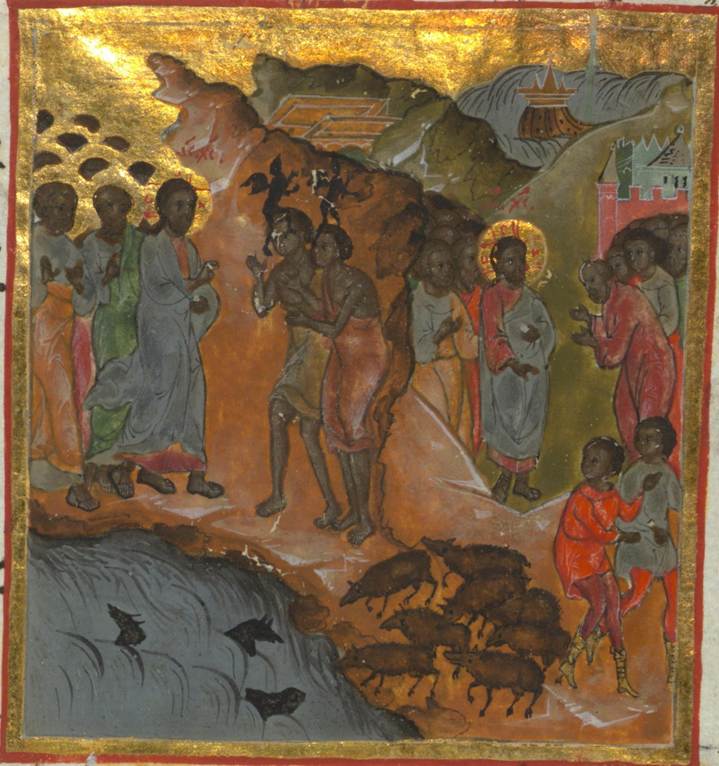
Figure 3 Anonymous Russian artists for Luke the Cypriot, after 1594 in the Walters Art Museum, and posted here.
[1] Mitchell Dahood, Psalms. 1: Psalms 1-50: Introduction, Translation and Notes, The Anchor Bible 17 (Doubleday, 1990).
[2] (אַשְׁרֵי הָאִישׁ– אֲשֶׁר לֹא הָלַךְ, בַּעֲצַת רְשָׁעִים; וּבְדֶרֶךְ חַטָּאִים, לֹא עָמָד, וּבְמוֹשַׁב לֵצִים, לֹא יָשָׁב. )
[3] since Yemen stopped in 2021.
[4] https://www.newsx.com/world/rent-free-in-democrats-heads-white-house-cryptic-social-media-post-sparks-online-meme-fest-over-the-weekend-113755/
[5] An observation made by https://edition.cnn.com/2026/01/19/us/donald-trump-memes-evolution-cec
[6] This is Joseph Goebbels – his media theory and Trump’s certainly have a lot in common. See: https://www.ibtimes.co.uk/these-joseph-goebbels-quotes-sound-lot-like-donald-trumps-media-strategy-1603865
[7] https://abcnews.com/Politics/sean-spicer-defends-alternative-facts-similar-conflicting-weather/story?id=45029364
Leave a Reply