Part I – A Bad Chapter
Yesterday, I read a shocking claim that seemed to belong in the pages of an exoticizing 19th century British travel-log, where authors regularly made-up scandalous claims about the natives they encountered to make their stories sensational enough to sell. However, the exotic place this book covered was the past, in fact, the Middle Ages. The natives, medieval Europeans.
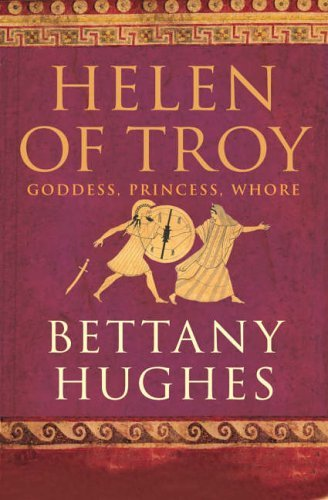
The book was on Helen of Troy, written by a classical historian, tracing the long and multivariant reception of Helen from the bronze age to today.[1] While medieval material is sprinkled throughout the book, the bulk of her analysis of the period between 200 and 1600 (a mere 1400 years) is contained in a short chapter called “Helen the Whore”. Now, the Middle Ages often gets short shrift in books about the long story of history – in a similar book on Jezebel, the entire period between the closing of the biblical canon (100, shall we say) and 1500 gets almost 6 pages. Another article, also on Jezebel, called “Jezebel in Jewish and Christian tradition” gets 25 pages. Now “Helen the Whore”, i.e. Helen for all of late antiquity and the Middle Ages? 5 pages of a 458 page book. A charitable reading would assume that the author just doesn’t think there’s anything worth saying about Helen in the Middle Ages. However, what she did write demands a less charitable reading.
“When Jospeh was writing in the 12th century, it was considered a sin for women to be on top during intercourse (144),” she writes, with no citation. She continues, “Anything other than the ‘missionary position’ was unnatural because it made the woman physically superior; it was the mark of a whore and was thought to pervert the course of semen, (144).” Once again, she does not include a citation or even a medieval author in a citation to support this fantastical claim. Later, she claims that the penance “for ‘unnatural’ sex positions…could last forty days or even more, (145)” once again without a citation or reference to any actual penitential manual. She then lists some typical penances for the period (including wearing a white hat) which she does not link to her claim about coital configurations, and the only specific evidence she offers (and applies anachronistically) are actually about adultery.
Finally, she cites one 11th century author, St. Peter Damian, who apparently “preaches a required period of twenty-five years fasting and penance for married couples of the age of twenty who have indulged in ‘deviant’ sexual positions,” but once again, this is without citation. I tracked down where Peter Damian discusses penances for married couples, and the only citation of his that matches the author’s description is not actually about unnatural sex positions – it is about homosexuality, in his Book of Gomorrah, quoting the Council of Ancyra’s canons on men sleeping with other men and bestiality.[2] The married couples here, are an extension of adultery – Peter prescribed different penance for men who also cheat on their wives when they have sex with other men. Further, the author fails to mention that Peter Damian is not just extreme, but unprecedented in many of his views regarding women and sexuality, and to use him as a representation of the mainstream is foolish and best and diabolical at worst.[3] He thought that the mistresses of priests should be made into slaves (in his Epist. 112.37).
To make matters even worse, she claims that “one late medieval theologian went so far as to say that God had sent the biblical Flood because he’d espied a couple having sex with the woman on top, (145).” Here, she does have a citation – but not of this mysterious theologian, but of another scholar. Slavomír Čéplö tracked the citation, and found that not only did the scholar cited contradict our author’s fantasy about the weird sexual obsessions of the Middle Ages (he says there was no consensus about this issue), he also just says that some theologian said this…and cites yet another scholar. When Slavo followed that citation, the Ur-scholar cited as the origin of this claim did not mention any medieval theologian obsessed with God’s voyeurism and was talking about something entirely unrelated. You can read about his process as part of a commentary on shoddy scholarship in his own blog post, here. But: Did someone actually say the flood was caused by God seeing the woman on top? Maybe. But right now, it’s impossible to verify that claim. The status of the claim “someone said God sent the Flood because a couple was in some non-standard position” is reading like an eighth-grade rumor about how Pat likes Sam (so said Alex who heard it from Jules’s sibling).
The author does not just skip over the Middle Ages – she creates a fantasy of the Middle Ages, and builds scholarly work based on that fantasy. She has a fantasy, specifically about the misogyny and weird sex-lives of Medieval people, and she is writing that as scholarship. She, modern scholar, is slaying the invented dragon of her vision of medieval misogyny.
Umberto Eco wrote a wonderful essay called “Dreaming of the Middle Ages”, published in English in Travels in Hyperreality – from which I take my title.[4] In it, Eco argues that Americans (and to a lesser extent, Europeans) are obsessed with dreaming of the Medieval past. There is a way in which “looking at the Middle Ages means looking at our infancy, in the same way that a doctor, to understand our present state of health, asks us about our childhood.”[5] From the Middle Ages there is the rise of the nation state and the federation, heresy as we know it, class struggle, trade unions, the conflict of church and state, and the rise of the printing press – as well as modern notions of love and the novel and happiness. Eco concludes that “our return to the Middle Ages is a quest for our roots.”[6] But the thing is, no one studies the history of the Middle Ages as an objective observer: we all have something at stake in how we remember it. The author of this book on Helen of Troy is no exception. Eco, fixated as he is on semiotics, claims that “since the Middle Ages have always been messed up in order to meet the vital requirements of different periods, it was impossible for them to always be messed up in the same way.”[7]
I think Eco’s right, here. And I think that without meaning to, this scholar of Helen of Troy substitutes a dream of the Middle Ages for real scholarship. She does so with the goal of liberating women – “Helen is the woman men love to love and love to hate, (146).” The story our author wants to tell is about misogyny in an “increasingly Christianized world, (143).” She claims that “when Helen is the active rather than the passive partner, men across time and space rush to label her a whore, (143).” If the Middle Ages is conceived, as it is in this book, as the transition from the pagan/polytheist world to the decline into darkness and repression of Christian tyranny, where we are struggling to come out on the other side, then the story this author tells makes sense. And because it reflects the story the author clearly already believes about the sexually repressed Dark Ages, the author doesn’t seem to mind that she is sharing a dream, or a strangely attractive nightmare, of the Middle Ages as a real chapter in Helen of Troy’s history.
I end with one last quote from our author, “Homer’s Helen was created in a time before good and evil were thought to be two vast magnetic forces…but for the Christianised West this was a difficult concept to deal with. Although the Christian writers do not dispute Helen’s breeding or deny her cultic crown, it is hard to describe Helen as very, very good and therefore she had to be very, very bad – in fact, a diabolical whore, (145).” Through her work on Helen, our author has written a fantasy about the Middle Ages that lets her tell a story about progress and decline. One of my students in Afghanistan, upon learning about how many distressing similarities there are between their lives now and the lives of ancient Roman women, asked me if I think progress exists at all for women.
Maybe it does. But the “trad” in TradWife is a fantasy, based on the same dreams of the Middle Ages that our purportedly feminist historian has – dreaming of a past that never was to support narratives of progress and degeneration. Perhaps more on this in a Part II.
[1] Bettany Hughes, Helen of Troy: Goddess, Princess, Whore (London: Random House, Jonathan Cape, 2005).
[2] Peter Damien, Book of Gomorrah 13.
[3] Fiona Griffiths, “Wives, Concubines, or Slaves? Peter Damian and Clerics’ Women,” Early Medieval Europe 30, no. 2 (2022): 266–90.
[4] Eco Umberto, “Dreaming of the Middle Ages,” in Travels in Hyper Reality : Essays (San Diego: Harcourt Brace Jovanovich, 1986), 61–72.
[5] Eco, “Dreaming of the Middle Ages,” 65.
[6] Eco, “Dreaming of the Middle Ages,” 65.
[7] Eco, “Dreaming of the Middle Ages,” 68.


Leave a Reply