Some Reflections on Directed Worry
Hawaiʻi is one of the last places to welcome in the New Year, though we are ahead of American Samoa (itself 70 kilometers from Samoa Samoa and the international date line – with a 24 hour time difference between the two)! Guam, the east and west coasts of the US, the Virgin islands and most other places in the US and the rest of the world have already entered 2026 as I write this, at 10:30pm HST on New Years Eve 2025. Most of the world has already moved on to the New Year. It always brings me a sense of discombobulation, I never feel quite as separated from the rest of the world as when I am home for New Years and in a different year.
New Years in Hawaiʻi is like nowhere else in the US.
However, this year, a year after the Āliamanu explosion, the lead up to New Years has been quiet.[1] The Honolulu Police Department reports only receiving 230 fireworks-related calls since Thanksgiving, compared to about 1,250 calls at the same time last year (2024).[2] The footage of the disaster has been playing over and over again on the news. Laws are stricter, the police have promised more enforcement, more fireworks have been confiscated/intercepted and so on. Officials are trying to focus our worry, our anxiety, on images of Āliamanu – the latest in a series of laws designed to protect us from ourselves, as part of Honolulu’s century long battle with fireworks which officially began in as 1926 became 1927.[3] By 2000, there was a statewide ban on aerials, and all consumer fireworks (including sparklers and fountains) followed on Oʻahu in 2010.[4]
But they couldn’t quite get us worried enough. I’ll ask you if you think there’s a fireworks ban, based on drone footage from midnight 2023 and 2024:
This year, though, our collective worry has been directed. It doesn’t quite sound like New Years – in the hours leading up the midnight, there are booms and crackles every few minutes, but compared to what it normally is, it is silent. Maybe everyone is waiting for midnight, to overwhelm the drones and police with so much chaos that they will escape fines. Maybe people are actually worried enough to give up – maybe this is a victory in the fight against fireworks in Honolulu that began with the death of 1926.
We’ll see, won’t we, what our worry amounts to. Midnight is coming.
***
I am writing a short series of posts about worry. As I was praying over the new year, I found myself dwelling on Philippians 4:6-7, in the New Living Translation which is the Bible translation I was raised with:
6 Don’t worry about anything; instead, pray about everything. Tell God what you need, and thank him for all he has done. 7 Then you will experience God’s peace, which exceeds anything we can understand. His peace will guard your hearts and minds as you live in Christ Jesus.
I realized that a younger Briana had a very clear idea about what that meant. Obviously, Paul was showing us that praying and worrying are diametrically opposed activities. Worry is ingratitude. Worry is the opposite of peace. The Philippians passage goes hand-and-hand with Matthew 6:25-34 (once again, in the NLT).
31 “So don’t worry about these things, saying, ‘What will we eat? What will we drink? What will we wear?’ 32 These things dominate the thoughts of unbelievers, but your heavenly Father already knows all your needs. 33 Seek the Kingdom of God above all else, and live righteously, and he will give you everything you need.
Worry is obviously the opposite of trusting in God, and means we don’t trust God with our lives. If you really think that God will take care of everything, you won’t worry. As verse 34 ends, “34 “So don’t worry about tomorrow, for tomorrow will bring its own worries. Today’s trouble is enough for today.” Worrying, the opposite of trusting God, the opposite of prayer, was focusing too much on tomorrow and not enough on what God was doing today. Worrying obviously could also not be counted as vigilance, as we are commanded to keep vigilant – like Ephesians 6:18 (also NLT), 18 Pray in the Spirit at all times and on every occasion. Stay alert and be persistent in your prayers for all believers everywhere or the parable of the wise and foolish virgins in Matthew 25.
At the time, it was clear: be vigilant but don’t worry. Pray constantly and have peace. Focus on today. Tell God what you need, and know that he already knows all your needs. It was all clear and straightforward, and I never really stopped to ask what this worry was.
But now, a little bit older than I was (and no longer a user of the NLT), I find that I’m not so sure anymore about what worry is in all these New Testament passages. What’s the difference between worrying for someone and praying for them without ceasing? What’s the difference between worrying about what to eat and drink, and asking for our daily bread (Matthew 6:11) – or asking our good father for good gifts (Matthew 7:9-11)? In short, what is the difference between worrying and praying?
This short blog series will explore this question.
***
It is 2026 now, we’ve crossed the threshold. It was a subdued New Years – much fewer fireworks in the sky, and much fewer injures. EMS reported only 6 fireworks related injuries (down from 110 last year), and the Honolulu Fire department reported only 2 fireworks-related fires (down from 30 last year).[5] This year fireworks did not shatter the windows on the businesses in our lane, and no shells landed on our lanai. The bulk of the displays were pau by 6 minutes after midnight, and it was quiet by 12:30. A tradition certainly has not died, but it has been subdued.
We did not light sparklers or hang rows of firecrackers from the telephone pole.
Did all the worry in the wake of Āliamanu do something?
Maybe. Will the caution people showed this year last?
Maybe.
But the thing about worry, like prayer, is it is fickle and tied to our attention. While generalized anxiety exists, I would argue that both worry and prayer are actions of attention that focus on particular things. The City and County of Honolulu put significant effort into directing our attention, directing our worry, towards the dangers of fireworks – and in doing so, made us act in a way that reduced the danger.
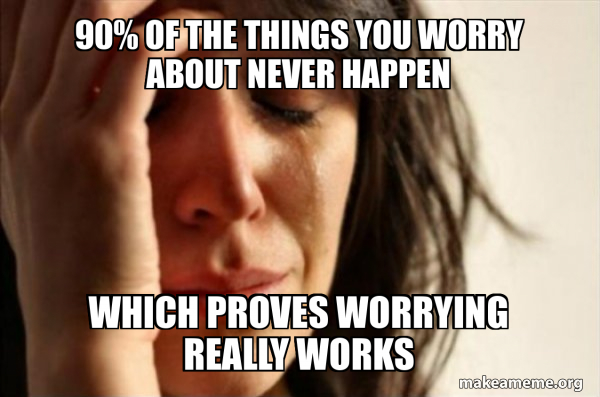
Source: https://makeameme.org/meme/90-of-the-4b970b5aa1
But how long can we stay vigilant? How long will that worry really last?
I suppose next year will tell.
[1] https://www.civilbeat.org/2025/12/fireworks-explosion-shattered-lives-will-hawaii-learn/
[2] https://www.hawaiipublicradio.org/local-news/2025-12-30/aliamanu-explosion-officials-urge-public-to-heed-fireworks-laws
[3] https://www.newsfromthestates.com/article/honolulu-has-been-struggling-regulate-fireworks-more-century
[4] https://hnldoc.ehawaii.gov/hnldoc/document-download?id=21737
[5] https://www.hawaiinewsnow.com/2026/01/01/ems-responds-multiple-possible-fireworks-related-injuries-new-years/
Leave a Reply